
Cooperative Aggregation & Mapping for Perception in Ubiquitous Sensing
This overview describes the proposed experiment. Trial deployment and benefits are planned, not completed results.
From shared observations to meaningful warnings
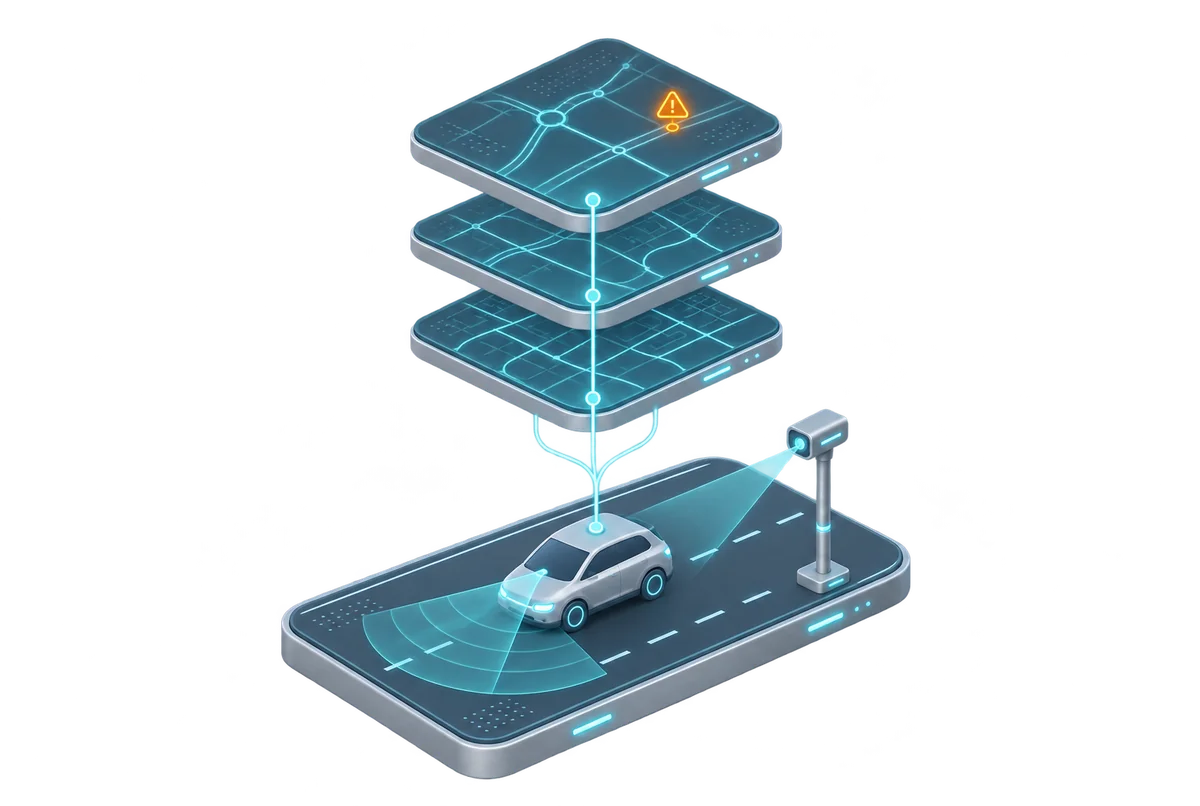
CAMPUS proposes a cooperative perception pipeline that combines camera and LiDAR observations from vehicles and mobile endpoints. Spatio-temporal fusion at the edge would turn these observations into dynamic HD-map updates, giving connected mobility applications a richer view of their surroundings.
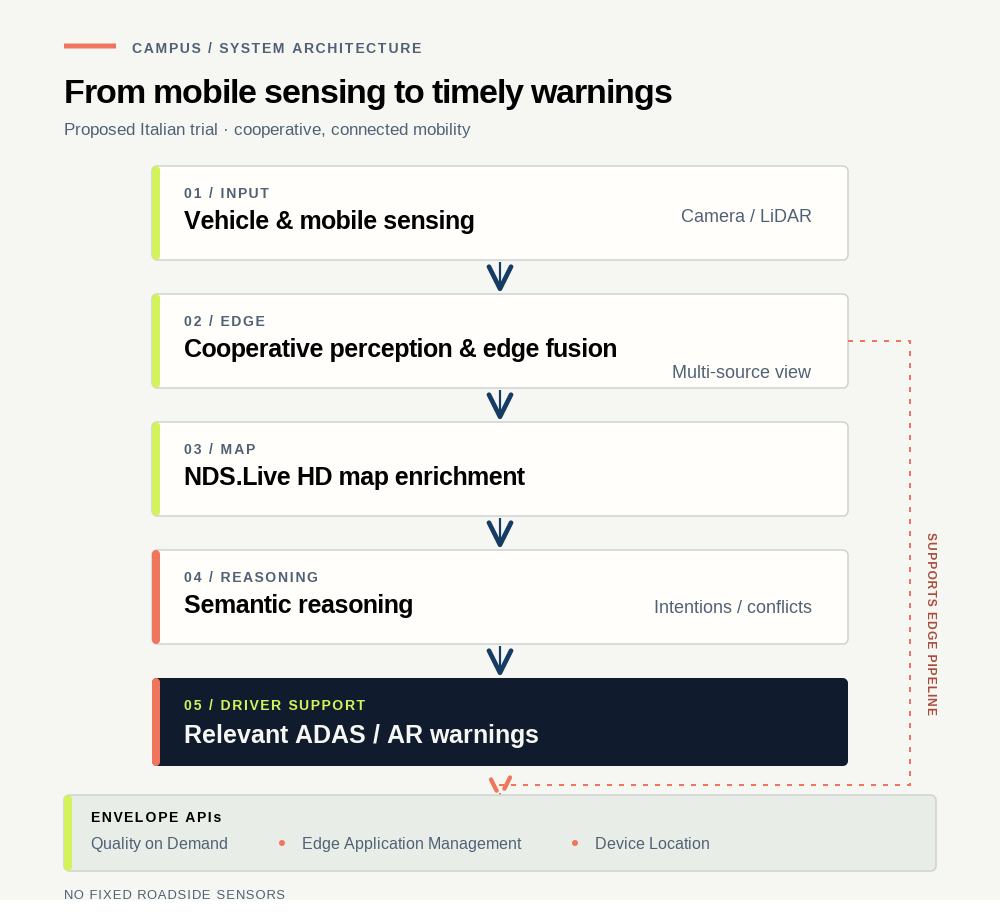
How the proposed pipeline would work
- Sense together. Vehicle and mobile cameras and LiDAR would contribute observations without relying on fixed roadside sensors or roadside units (RSUs).
- Fuse at the edge. Cooperative perception would align observations in space and time to build a shared situational picture.
- Enrich the map. Dynamic observations would augment NDS.Live-compatible HD maps alongside their static layers.
- Reason about the scene. Semantic reasoning would enrich the map with inferred intentions and explanations of potential conflicts, rather than operating as a separate decision module.
- Deliver relevant updates. Relevance filtering would select the information needed for advanced driver-assistance systems (ADAS) and augmented-reality (AR) warnings.
HiveIntel’s proposed contribution
HiveIntel would contribute semantic map enrichment, reasoning mechanisms, and efficiency-aware AI components for edge and far-edge deployment. The aim is to connect sensor observations with knowledge-centric interpretation while accounting for constrained computing resources.
Connecting to ENVELOPE
The proposed integration would use three ENVELOPE APIs to connect application needs with network and edge capabilities:
- Quality on Demand: support application-aware network quality through a QoS controller.
- Edge Application Management: support deployment management for edge workloads.
- Device Location: provide location context for the perception and mapping pipeline.
Proposed trial environment
CAMPUS proposes validation at the Italian ENVELOPE trial site, using B5G/5G standalone connectivity and GPU-enabled edge resources. Sensing would come from vehicles and mobile endpoints, with no fixed roadside sensor infrastructure required.
What the experiment aims to explore
The intended benefits are a more complete situational picture, explainable warnings, and efficient delivery of relevant information. The experiment would investigate how cooperative sensing, semantic maps, and network-aware edge deployment can support these goals; no achieved performance improvements are claimed here.