
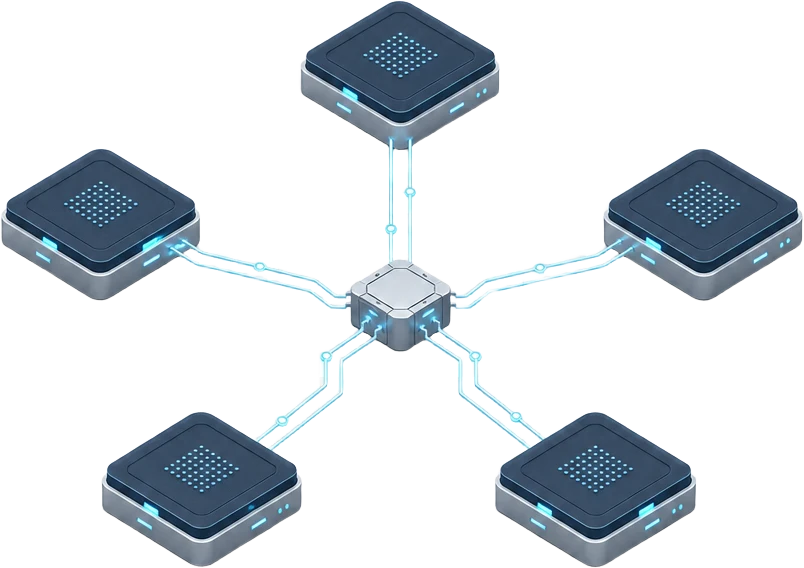
Energy-aware Swarm Intelligence with Small Language Models (SLMs)
What is SLM-Bench?
SLM-Bench is an energy- and efficiency-aware benchmarking product for Small Language Models. Rather than selecting a model on accuracy alone, it brings together quality, latency, cost, power and carbon indicators to help teams understand the trade-offs for their hardware, budget and workload.

Three dimensions of model performance
- Correctness: evaluate answer quality with task-specific metrics such as accuracy and F1 for classification and question answering, and BLEU, ROUGE and METEOR for generation.
- Computation: compare runtime and compute indicators to assess speed and execution requirements.
- Consumption: compare energy usage, cost and CO₂ emissions alongside model quality.
Hardware-aware comparisons
The benchmark website presents rankings for GPU profiles including NVIDIA L4 and A10G, with gold, silver and bronze indicators to make comparisons easier to scan. Its evaluation approach uses controlled hardware conditions and standardized protocols. Visit the external leaderboard for detailed model results rather than treating this overview as a fixed ranking.
A reproducible evaluation workflow
The SLM-Bench pipeline covers the full evaluation process:
- Load diverse datasets through a common interface.
- Preprocess inputs for each task.
- Run candidate models consistently.
- Clean and structure the model outputs.
- Compute correctness and efficiency metrics.
- Produce reports, tables and visualizations.
- Log runs for traceability and iteration.
From benchmarks to an energy-aware swarm
Different models can suit different priorities. Comparing quality, runtime and consumption helps teams design multi-model routing policies: choose a model that fits the request’s quality target, latency budget and power constraints instead of using one model for every task.
Where it can help
- Select models for on-device assistants, edge devices and on-premises GPUs.
- Compare candidates before a production rollout.
- Support model choices with cost, energy and carbon measurements.
- Track efficiency changes across model upgrades.
- Develop routing policies for multi-model systems.
This overview summarizes the SLM-Bench website. Refer to that source for detailed benchmarks and implementation information.